Mount Stupid: The Most Dangerous Place on a Motorcycle
Getting over Mount Stupid
What exactly is Mount Stupid?
You may have heard of the Dunning-Kruger effect.
In 1999, psychologists Justin Kruger and David Dunning published research examining people's ability to judge their own competence. One of their central observations was that people who performed poorly in a particular domain could also struggle to recognise how poorly they had performed. In other words, the skills needed to perform a task can overlap with the skills needed to judge your performance at that task. (PubMed)
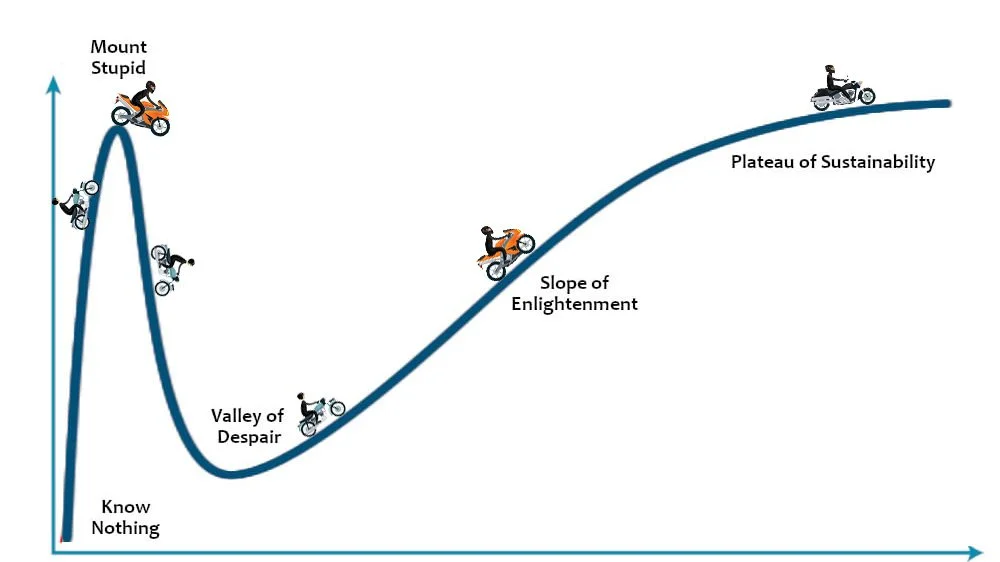
The internet has subsequently turned this into a wonderfully simple illustration.
You start knowing very little.
You learn a few things.
Suddenly, you think you've got it.
Your confidence shoots upwards.
You reach the top.
Mount Stupid.
From there, as you learn more, you begin to discover just how much you don't know.
Your confidence may take a bit of a battering.
Eventually, competence and confidence begin to align.
It's a great metaphor.
But there's something especially interesting about it when you put a motorcycle underneath you.
Because motorcycling is full of things you can do reasonably well without necessarily understanding how well you're actually doing them.
And that can be dangerous.
"But I've been riding for years!"
This is usually where the conversation gets interesting.
Imagine you've been riding motorcycles for 20 or 30 years.
You've ridden in rain.
You've ridden in the dark.
You've ridden in Europe.
You've ridden fast.
You've ridden slowly.
You've dealt with traffic, tractors, potholes, diesel spills, gravel, sheep and the occasional idiot who appears to have obtained a driving licence from a cereal packet.
You've survived all of it.
So naturally, you consider yourself an experienced rider.
And you are.
But here's the catch.
Experience and competence aren't necessarily the same thing.
Experience tells you what you've done.
It doesn't necessarily tell you whether you've done it well.
That's an important distinction.
The returning rider has a particular problem
This is especially relevant to what we might call the born-again biker.
You rode motorcycles when you were younger.
Then life happened.
Perhaps you got married.
Children arrived.
There was a mortgage.
Work became demanding.
Maybe your knees started making noises every time you climbed stairs.
So the bike went.
Years later, circumstances change.
You suddenly find yourself with the time, money and inclination to get back on two wheels.
And something fascinating happens.
You don't return to motorcycling as a novice.
You return with years of accumulated life experience.
You're older.
You're more mature.
You've driven cars for years.
You've developed judgement.
You've probably become considerably better at assessing risk.
You may have spent decades making complicated decisions every single day.
So when you climb back onto a motorcycle, it is perfectly understandable to think:
"I've got this."
And perhaps you have.
But perhaps you've also just climbed onto Mount Stupid.
Life experience isn't motorcycle experience
This isn't an insult.
Your life experience absolutely matters.
But motorcycles have a nasty habit of exposing the difference between general experience and motorcycle-specific skill.
A motorcycle asks you to understand things such as:
observation
positioning
speed management
cornering
braking
steering
traction
hazard perception
overtaking
road surface
visibility
planning
and the interaction between all of them.
These aren't simply things you know about.
They're things you do.
And doing them effectively requires skill.
The problem is that you can get away with doing some of them badly for a very long time.
Experience can hide your mistakes
Take cornering.
Perhaps you've been riding the same sort of bend for years.
You approach.
You slow down.
You turn.
You apply counter steer
The bike leans.
You exit.
Nothing happens.
Brilliant.
Except perhaps you've been:
entering too quickly;
braking too late;
looking too close to the motorcycle;
positioning poorly;
staring at the hazard;
relying on grip you didn't actually need to use;
or simply getting away with it because the road was forgiving.
You haven't received any negative feedback.
So your brain files the whole thing under:
"I can do corners."
And the next time you do it exactly the same way.
And the next.
And the next.
Suddenly you have 20 years of experience.
But you might also have 20 years of the same unexamined habit.
That's the uncomfortable bit.
The question nobody likes
Here's the question that really matters:
If you're doing something wrong and you don't know you're doing it wrong, how would you know?
Think about that for a moment.
You can't identify a blind spot by looking through it.
You can't recognise a technique you don't know exists.
You can't easily identify a weakness in your riding if you've never had anyone point it out.
And this applies everywhere.
Cornering
You might think you're good at corners.
But are you actually using your vision, speed and road position effectively?
Or are you simply getting around them?
There is a difference.
Braking
You can stop your motorcycle.
Of course you can.
But are you using the brakes progressively and effectively?
Do you know how your motorcycle behaves under hard braking?
Would you be able to stop effectively if something genuinely unexpected appeared?
Observation
You look where you're going.
Everyone does.
But are you actually seeing?
Are you recognising clues that something may develop before it becomes a problem?
Are you looking far enough ahead?
Are you identifying escape routes?
Or are you simply reacting to whatever appears in front of you?
Positioning
You may have a preferred position on the road.
But is it giving you the best possible view?
Is it creating appropriate safety margins?
Are you positioning deliberately or simply riding where you've always ridden?
Overtaking
You may consider yourself a confident overtaker.
But confidence isn't the same thing as planning.
Are you gathering enough information before committing?
Are you considering what could happen next?
Are you creating an escape route?
Or are you simply thinking:
"I've got enough room."
Wet roads
And then there's rain.
Many riders become tense.
They slow down.
They grip the bars tightly.
They stare at the road immediately ahead.
They worry about the tyres letting go.
Yet modern motorcycle tyres are remarkably capable.
The problem isn't necessarily the grip.
Sometimes the problem is understanding how to use it.
The SmoothRider Principles
At SmoothRider, we don't believe good motorcycle riding is about being the fastest rider on the road.
It's not about taking risks.
It's not about proving something to your mates.
And it certainly isn't about how many years you've been riding.
It's about having the knowledge, skills and awareness to make good decisions consistently.
That's why the SmoothRider approach is built around a number of fundamental principles.
Observation
See more. See earlier. See better.
You can't respond effectively to something you haven't seen.
Good observation isn't simply looking ahead. It's recognising what you're seeing, identifying developing hazards and constantly asking:
"What might happen next?"
Positioning
Put the motorcycle where it gives you information and options.
Good positioning can improve visibility, increase safety margins and give you more time to respond.
It's not about following a magic line through every corner.
It's about using the road intelligently.
Speed Management
Ride at a speed that allows you to deal with what you can see.
The question isn't:
"How fast can I go?"
It's:
"Can I comfortably deal with everything I can see from here?"
Planning
Don't just react to the road. Read it.
Good riders aren't simply reacting to hazards.
They're anticipating them.
They're thinking about what comes next and preparing for it before they arrive.
Smoothness
Smooth is controlled. Controlled gives you options.
Braking, steering, acceleration and changes of direction should work together.
Smooth riding isn't necessarily slow riding.
It's about making deliberate inputs that keep the motorcycle settled.
Grip
Respect the grip you have — but don't be frightened of it.
Tyres are remarkably capable.
But grip isn't infinite, and it isn't available equally for braking, steering and acceleration at the same time.
Understanding grip allows you to use it intelligently.
Adaptability
There isn't one perfect riding technique for every situation.
Dry road.
Wet road.
Cold tyres.
Traffic.
Poor visibility.
Different motorcycle.
Different road surface.
Different hazards.
Good riders adapt.
Self-Awareness
Confidence should be based on competence, not assumption.
This may be the most important principle of all.
You need confidence to ride well.
But you also need enough self-awareness to recognise when there is something you don't know.
Or something you could do better.
That isn't weakness.
It's maturity.
Continuous Development
The best riders never stop learning.
You don't need to be a beginner to benefit from coaching.
In fact, the more experienced you become, the more valuable another perspective can be.
Because another rider watching you can see things that you simply cannot see from the saddle.
And that brings us straight back to Mount Stupid.
The problem with being good enough
There's another trap here.
You don't have to be a terrible rider to benefit from coaching.
You can actually be a pretty good rider.
And still have things to improve.
You might already have excellent observation but weak positioning.
You might be confident in corners but less comfortable with emergency braking.
You might be smooth but overly cautious.
You might be quick but not particularly good at planning.
Or you might be doing nearly everything well but have one bad habit that you've never noticed.
Motorcycling isn't a single skill.
It's a collection of skills that interact with one another.
Improving one can improve the others.
And sometimes, the only way to discover where the gaps are is to have someone else watch.
The best riders aren't afraid to learn
Talk to genuinely accomplished riders and you'll often hear something surprising.
They don't tell you they know everything.
They'll tell you they're still learning.
They'll discuss mistakes they've made.
They'll talk about things they used to do differently.
They'll ask questions.
They'll seek feedback.
They remain curious.
That's not insecurity.
It's self-awareness.
The rider who says:
"I've been riding for 30 years. I don't need training."
may be absolutely right.
But there's another possibility.
Perhaps they've spent 30 years becoming very good at the things they already know.
And nobody has shown them the things they don't.
So where are you on the mountain?
Perhaps you're a new rider.
Perhaps you've been riding for years.
Perhaps you're one of those returning riders who has rediscovered the motorcycle after a decade or two away.
Perhaps you've got thousands of miles under your belt.
Maybe you're genuinely an excellent rider.
But ask yourself:
How do you know?
Not as an accusation.
Not as an insult.
As an honest question.
Because if you can identify your weaknesses, you can work on them.
If you can accept that there are things you don't know, you can learn them.
And if someone else can identify something that you couldn't see yourself...
that's not failure.
That's progress.
Getting off Mount Stupid
The answer isn't to lose your confidence.
It's to calibrate it.
Good coaching isn't about someone telling you how to ride your motorcycle.
It isn't about treating an experienced rider like a learner.
And it certainly isn't about making you feel inadequate.
It's about another experienced pair of eyes watching what you do and asking:
"Could we make that better?"
Perhaps you'll discover that you're already doing something brilliantly.
Perhaps you'll find a few habits that could be polished.
Perhaps you'll discover that something you've been doing for 20 years isn't quite as effective as you thought.
That's okay.
Because now you know.
And once you know, you can do something about it.
You Don't Know What You Don't Know
That's perhaps the biggest challenge in motorcycle riding.
We know what we know.
We know what we've experienced.
We know what has worked for us.
But there is an enormous gap between:
"I've always done it this way."
and
"I know this is the best way to do it."
That gap is where learning lives.
And it's also where better riding begins.
So don't ask yourself:
"Am I a good rider?"
Ask yourself:
"What am I doing on my motorcycle that I don't know I'm doing?"
And then ask the really uncomfortable question:
How would I know?
You might discover that you're already riding brilliantly.
You might discover a few habits that could be improved.
You might discover that something you've been doing for years isn't as effective as you thought.
That's not failure.
That's development.
And if you want to find out what you don't know you don't know...
Take some coaching.
Your ego will probably survive.
Your riding might just get better.
And that's what SmoothRider is about.
About SmoothRider
SmoothRider provides personalised one-to-one motorcycle mentoring to help riders become smoother, safer and more confident. Through practical coaching on real roads, you'll learn how observation, planning and smooth control inputs work together to make every journey more enjoyable.