What a Single Photograph Can Reveal About Your Riding ⭐⭐⭐⭐⭐
A40 Rider Analysis: What a Photograph Can Teach Us About Road Positioning
Spend any time on social media and you'll see hundreds of fantastic photographs of motorcyclists enjoying some of Britain's best roads. They capture the excitement of motorcycling perfectly—the lean angle, the scenery and that wonderful feeling of flowing through a bend.
Recently I was looking through a series of superb photographs taken by the motorcycle photographer WeAreBikers on one of Wales' favourite biking roads, the A40 near Llandovery.
The photographs themselves are excellent. The clean green background, the sweeping curve of the road and the way each rider is captured mid-corner all combine to create striking images.
But as I looked through them, I found myself studying something else.
Not the motorcycles.
Not the lean angles.
The road positioning.
Looking Beyond the Photograph
Using Google Earth, it appears the photographer was positioned in a small lay-by on the outside of a sweeping right-hand bend, facing east away from Llandovery.
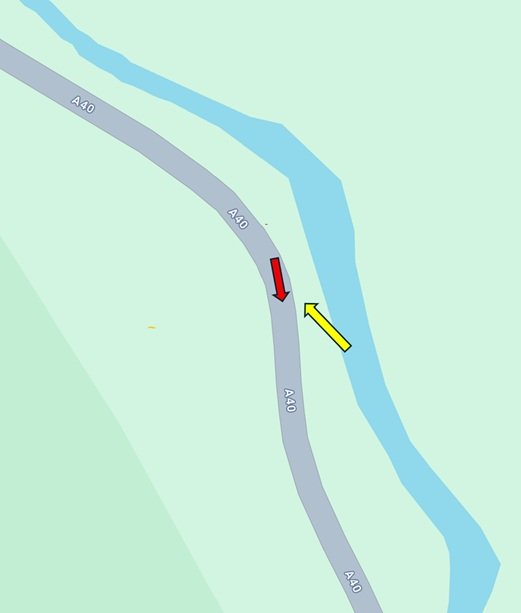
From the camera's perspective the riders look committed and smooth.
From a rider development perspective, however, the photographs tell another story.
Almost every rider has adopted a similar position through the corner.
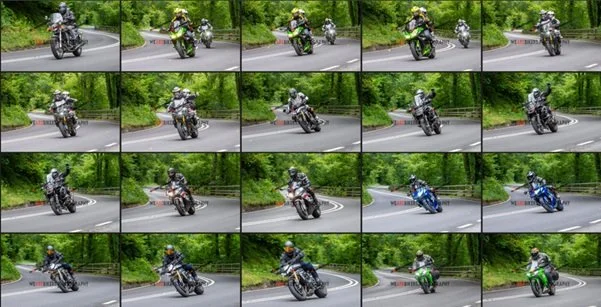
Almost without exception the riders adopted a slower less safe position in the road
The question is:
Is it the position that gives the greatest safety margin?
The Bend We Can't See
The important thing about this particular corner is not what the camera sees.
It's what the rider can't see.
This is effectively a blind right-hand bend.
As you approach it, your view of oncoming traffic is restricted by the bend itself.
That means you have incomplete information.
And whenever information is limited, good roadcraft tells us to increase our safety margin rather than reduce it.
Position for Information, Not for the Photograph
One of the fundamental principles taught in Roadcraft, BikeSafe, the IAM, and by SmoothRider, is that road position should always be chosen to maximise information.
On the approach to a blind right-hand bend, this usually means moving towards the nearside of your lane.
Why?
Because every metre you move left opens your view a little further around the bend.
That extra view gives you:
more time
more information
more options
Most importantly, it increases the distance between you and any vehicle that may appear close to—or even across—the centre line.
Waiting for the Road to Tell You
Many riders begin moving towards the centre of the lane far too early.
The result is that they effectively tighten the corner for themselves.
Their view is reduced.
Their escape options become fewer.
They often delay opening the throttle because they simply can't yet see that the road is clear.
Advanced riders work differently.
They remain patient.
They hold the nearside position until the limit point—the furthest point of road they can see—begins to move away.
That movement tells them the bend is opening.
Only then do they progressively move back towards the centre of their lane, allowing them to straighten the bend, see further ahead and apply the throttle smoothly and confidently.
Ironically, by waiting longer, they are often able to accelerate earlier.
What the Photographs Reveal
Looking closely at several of the riders in these photographs, many are positioned very close to the double solid white lines on the exit of the bend.
One rider is so close that part of the motorcycle appears to extend slightly over the centre line.
This isn't about criticising that rider.
It is simply an illustration of how easily we can all drift towards the centre of the road without realising it.
If an oncoming motorcycle were also positioned close to the centre line, or if a coach, agricultural vehicle or HGV appeared using more of its lane, the available space between the two vehicles would reduce dramatically.
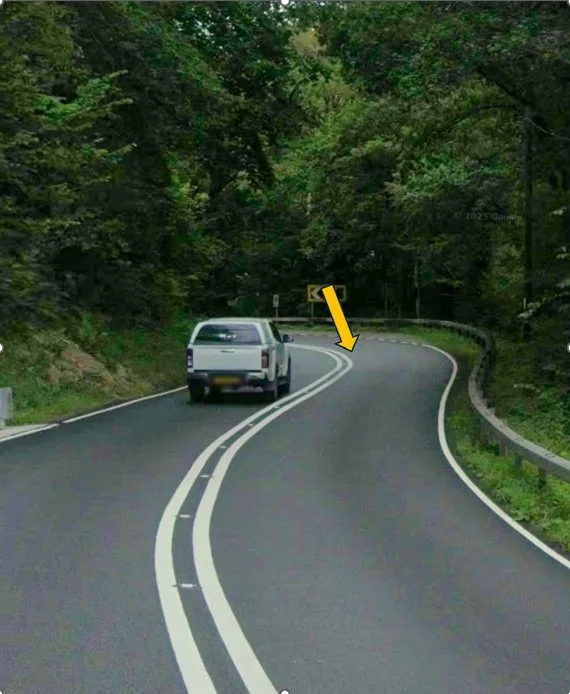
Should a wider vehicle have been where this 4×4 is a rider coming in the opposite direction positioned where the arrow is would be compromised
The rider has fewer options simply because of where they have chosen to place the motorcycle.
The Best Riders Don't Chase the Centre Line
Many riders believe that riding close to the centre line makes them smoother or faster.
In reality, it often achieves the opposite.
It reduces vision.
It delays information.
It increases risk.
The fastest advanced road riders are rarely those who attack every bend.
They are the riders who gather the most information before making every decision.
Information creates confidence.
Confidence allows smoothness.
Smoothness often leads to progress that feels effortless.
Every Photograph Tells a Story
One of the fascinating things about motorcycle photography is that a single image captures far more than lean angle.
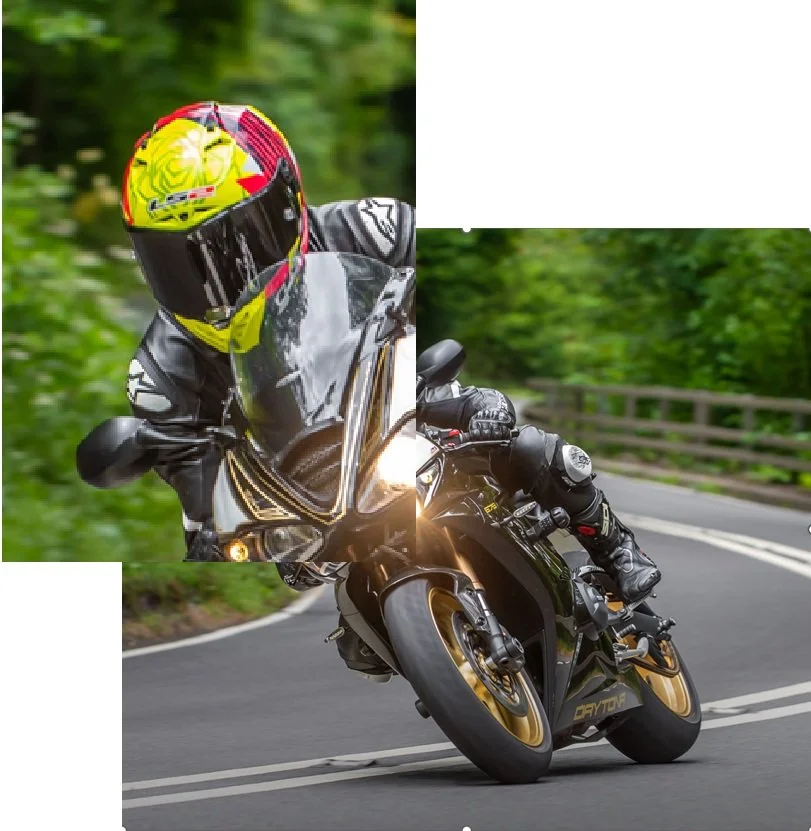
In this excellent image of the rider on a black Daytona you can actually see in the reflection in the visor (enlarged) that the bars cross the white lines.
It captures:
road position
body position
vision
planning
safety margins
confidence
habits
Sometimes those habits are excellent.
Sometimes they reveal opportunities for improvement.
Every one of us—including experienced riders—can learn something by studying our own riding.
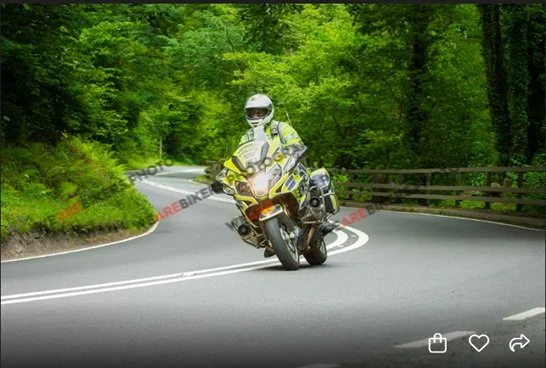
This police motorcyclist has also adopted a very central position in the road. Should he or has he made an error?
The SmoothRider Approach
At SmoothRider, we don't coach riders to copy someone else's line.
We coach them to understand why they choose a particular position on the road.
Good positioning isn't about looking impressive in a photograph.
It's about seeing earlier.
Planning sooner.
Keeping your options open.
And always leaving yourself a safety margin for the unexpected.
Because on the road, the best line isn't the one that creates the best photograph.
It's the one that gets you safely to the next bend.
About SmoothRider
SmoothRider provides personalised one-to-one motorcycle mentoring to help riders become smoother, safer and more confident. Through practical coaching on real roads, you'll learn how observation, planning and smooth control inputs work together to make every journey more enjoyable.