When will my Tyres let go?
Motorcycle Tyres: How Much Grip Do You Really Have?
Ask almost any motorcyclist what concerns them most in a bend and you'll often hear the same answer.
"I'm worried the tyres might lose grip."
It's a perfectly understandable concern.
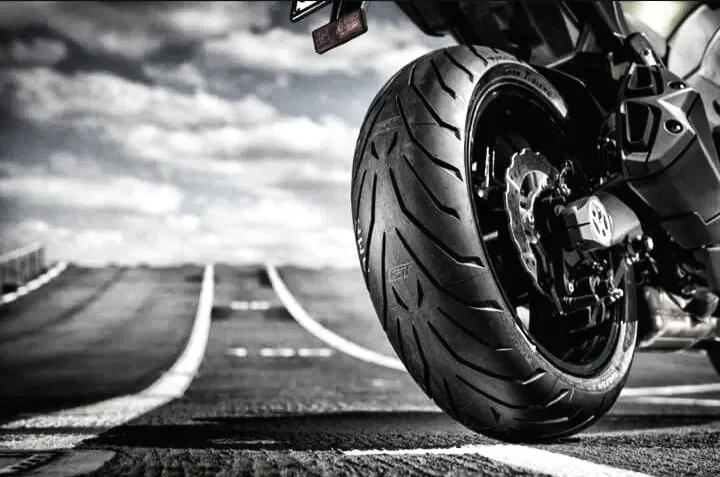
After all, your entire motorcycle is connected to the road by just two small contact patches, each little larger than the palm of your hand.
It doesn't sound like much.
But here's the good news.
On a clean road, with modern tyres in good condition, most riders use only a fraction of the grip available. It's usually our riding inputs—braking, accelerating or cornering too abruptly—or encountering a poor road surface that reduce the tyre's available grip.
The tyres themselves are rarely the weak link.
Understanding how grip works is one of the keys to becoming a smoother, safer and more confident rider.
Grip Isn't Something You Either Have or Don't Have
Many riders think of grip as a simple on/off switch.
Either the tyres grip...
...or they don't.
In reality, grip is much more like a budget.
Imagine your tyres have 100% of their available grip.
Every time you ride, you're asking those tyres to perform three different tasks:
Braking
Cornering
Accelerating
The more grip you use for one task, the less remains for the others.
This is why advanced riders strive to make every control input smooth and progressive.
Braking and Turning – Sharing the Grip
Let's imagine you're approaching a bend.
You brake while the motorcycle is upright.
Almost all of the available grip can now be used for slowing the motorcycle.
As you reach your chosen entry speed, you progressively release the brakes before leaning into the bend.
Now the tyre can devote almost all of its grip to cornering.
Everything feels calm and settled.
But what happens if you arrive too fast?
Now you're trying to brake hard while also asking the tyre to steer.
Both braking and cornering are competing for the same grip.
On a dry, clean road there may still be enough available.
On wet roads, loose gravel, diesel spills or muddy surfaces, your safety margin becomes much smaller.
The tyre hasn't suddenly become less capable.
You've simply asked it to do more than the conditions allow.
The Road Decides How Much Grip You Have
No two roads are ever identical.
One bend may offer excellent grip.
The next may contain:
Mud dragged onto the road by a tractor.
Loose gravel.
Wet leaves.
Painted road markings.
Diesel spills.
Standing water.
Potholes.
Your tyres can only work with the grip the road provides.
That's why advanced riders spend as much time reading the road surface as they do looking at the bend itself.
The road is constantly asking questions.
Good riders are constantly looking for the answers.
Smooth Riders Don't Need Maximum Grip
One of the biggest misconceptions in motorcycling is that the best riders use all of the available grip.
In reality, the opposite is often true.
The smoothest riders deliberately leave themselves a margin.
They plan further ahead.
Brake earlier.
Release the brakes progressively.
Lean the motorcycle smoothly.
Accelerate gently as the bike begins to stand upright again.
Because every input is calm and measured, the tyres are never overloaded.
The result is a motorcycle that feels balanced, predictable and confidence inspiring.
Confidence Through Understanding
Many riders gain confidence simply by covering more miles.
Experience is valuable.
But confidence built purely on mileage isn't always confidence built on understanding.
Real confidence comes from knowing why the motorcycle behaves as it does.
Once you understand that braking, steering and acceleration all share the same available grip, your riding naturally becomes smoother.
You begin planning earlier.
You stop rushing corners.
You leave yourself more options.
And, perhaps most importantly, you leave yourself a greater safety margin when the unexpected happens.
The SmoothRider Approach
At SmoothRider, we don't teach riders to discover the limits of grip.
We teach them how to ride so smoothly that they rarely need to approach those limits in the first place.
Better observation.
Earlier planning.
Progressive braking.
Smooth steering.
Gentle acceleration.
All of these reduce the demands placed on the tyres and increase the safety margin available to you.
Because the goal isn't to see how much grip your tyres have.
It's to ride in a way that means you rarely need all of it.
Food for Thought
The tyres on your motorcycle are capable of extraordinary levels of grip.
The question isn't whether they'll grip.
The question is whether your riding allows them to work at their best.
The smoothest riders aren't those who use the most grip.
They're the ones who always leave a little in reserve.
Ready to Ride with More Confidence?
Understanding grip is one thing—putting that knowledge into practice is where real progress happens. At SmoothRider, our one-to-one post-test coaching helps riders develop smoother machine control, better observation and more effective planning on real roads. If you'd like to feel more confident in every bend and enjoy every ride with a greater safety margin, we'd be delighted to help.
About SmoothRider
SmoothRider provides personalised one-to-one motorcycle mentoring to help riders become smoother, safer and more confident. Through practical coaching on real roads, you'll learn how observation, planning and smooth control inputs work together to make every journey more enjoyable.