Important Information
The Forgotten Essential
I am a keen contributor and follower of various Facebook groups. It help keep me aware of new issues with my bike, travel experiences, etc. Across all the groups I often many problems, queries, and questions raised that should never come up. These can also be fundamental details that affect the efficient, safe, and comfortable use of your chosen motorcycle. I mean any motorcycle. This common issue spreads across almost all bike types.
What I am talking about is when questions such as this arise; How much oil do I need for an oil change, What type of oil, Should I change the suspension settings when carrying a pillion, How do I change the suspension settings, What does a particular icon on my, increasingly data rich, screen mean. At first sight these are all questions that seem to be very valid so why do I say that they should never be asked in the first place?
The reason is that everybody has the answer to those questions readily to hand. Also the answers are definitive answers from absolute experts who have spent thousands of hours and possibly hundreds of thousands of miles gaining experience in your specific motorcycle. Not a well-meaning amateur pundit with some hearsay and subjective opinion. What I am talking about is a little goldmine of information about your bike, the owner’s manual.
The owner’s manual! What do I need that for? I’m a bloke, they usually are that ask these questions, I passed my test, I can ride a bike, I just turn the key, press the starter and there you go. I know where the brakes are, the gear change, and the clutch. I can indicate left and right and if it gets dark, I know where the lights are. Anyway, a modern bike nearly always have the low beam lights on anyway. I am sorted. But are you really?
Back in the dark ages of motorcycles you wouldn’t have been sorted, not even for these basics. Much was decided by individual manufacturers. Gear levers could be on either side of the bike or even by hand, 1 down and 5 up! Not a chance. There might be a hand or foot clutch, light controls could be anywhere. You really had to know your bike to operate it well. Then US legislation forced manufactures to place the major controls in a set of unified locations, so now we can, at least at the most basic level jump on any modern bike secure in the knowledge that squeezing the right lever will apply at least the front brake.
But motorcycling has always been much that just operating your machine at a basic level. To get the most out of it in terms of performance, comfort, safety, and reliability we really need to understand it more intimately and more instinctively and that’s where out owner’s manual is so valuable.
What’s in it that I need to know?
For this article I am going to take as an example the owner’s manual from my 2017 Triumph Explorer XCA. This A5 black book runs to 190 pages!! That’s virtually a novel. That’s going to take me a week to get through and I need to get out and ride the bike, that’s where I’ll really get to know it. To anybody with that attitude I say hold on, take a breath and calm down. Read the manual.
The question is where to read this manual. I guess I am like many others in that when I have decided on the bike I want and signed on the dotted line I can wait to get it. I literally count how many sleeps are left before delivery. To aid my impatience I usually download a PDF of the bike manual. Then I read it before I get the bike. At least that gets me into the mindset of what the bike is capable of and how to make it fulfil those capabilities. I may not have hands knowledge of the geography of the physical attributes of the bike, but I am building up the picture.
Now I have the bike I go through the next step. I walk around the bike and check everything, and when I am happy it has two round wheels, and an engine that makes noise and gets hot I sit on the bike and open the manual.
Firstly, a great deal of the manual is dedicated to warning you to not touch this, that motorcycling is a dangerous pastime, or that the manufacture accepts no responsibility for the fact that you just spent thousands of pounds to by one of their shiny new machines. That means in fact there is a lot less informative reading to do.
The first 13 pages in mine for example are devoted to the Foreword, Safety First and the position of the various Safety Labels on the bike at the back of the manual three pages are the index. So that is effectively 174 pages to read.
Now we get a couple of pages labelling and telling you where the individual parts of the bike are on the next page the cockpit is laid out and labelled. Pay attention to this. This is when you find out where those ancillary switches and buttons for many of the ‘vital’ functions are placed. What better placed to build the muscle memory that sitting on the bike in the calm of the garage, far better than being out in the dark and wet and wishing you could remember how to change to rain mode rather than try to tip toe home in Race or Sport!
There are sections on the display, with explanations about what each and every icon means, how to set and customise modes if you have them. How to set the suspension for solo, pillion or riding with luggage. How to set the dash to show you what you want to see. Would you prefer to see ‘range to empty’ or ‘Average speed’ each to there own but without the manual you’d just be poking a buttons and scrolling through endless pages. Importantly and usually at the back of the bike there are the specifications. These will tell you important information such as what type and how much oil you bike requires, maximum payloads, often overlooked especially by corpulent riders on their big tour/adventure, and what settings should be used and how to set them to optimise the handling for your bike.
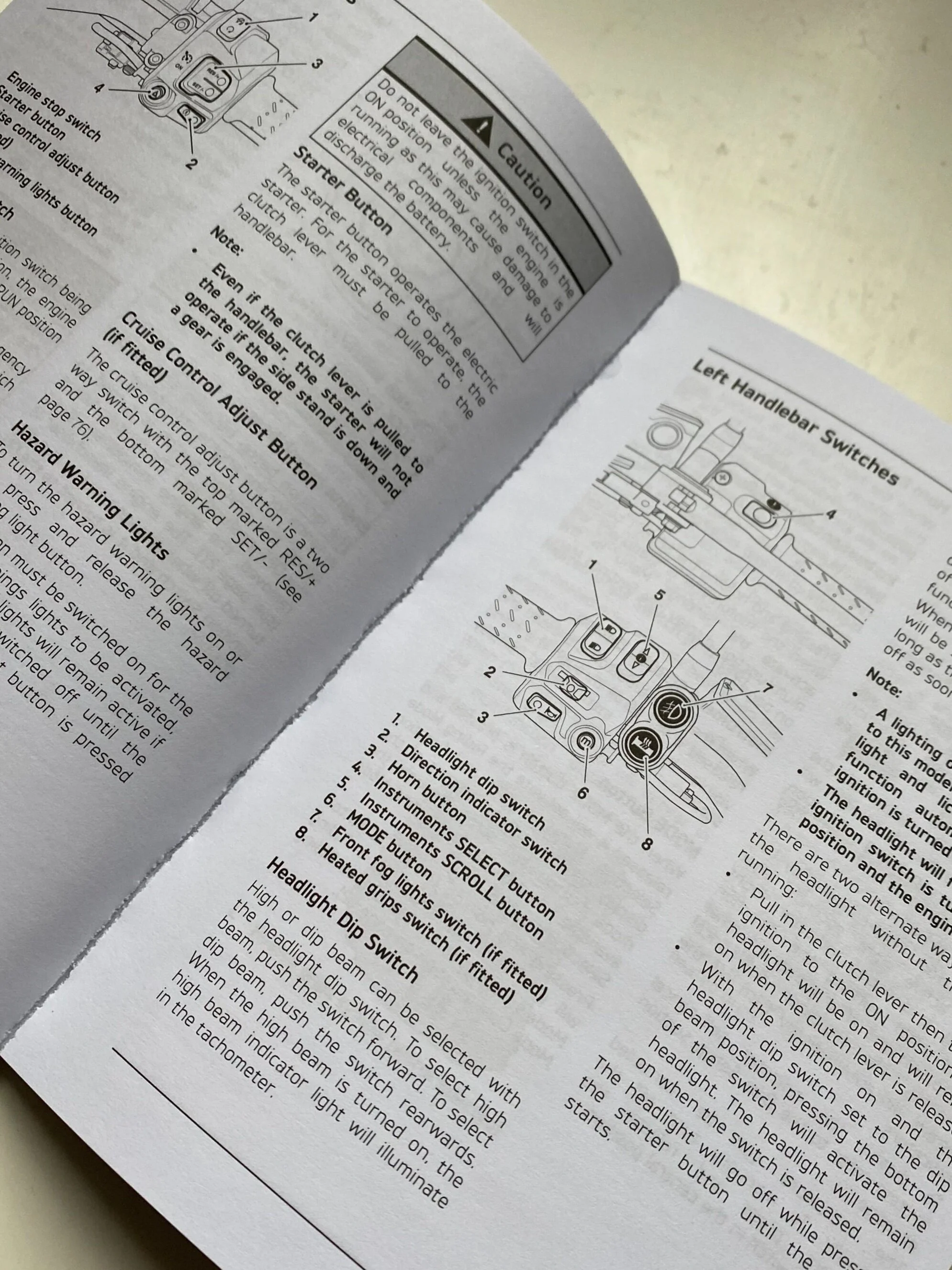
Even the most basics are there. I have seen riders ask why they cannot start their bike. After some toing and froing in it transpires that they have forgotten to hold the clutch in, something you must do on a Triumph even if it is neutral. Other brands of bike have different procedures.
With the way bikes are going the are sure to be pages and pages of information relating to technology, modes and setting. Many ‘old school’ riders will say they don’t need or don’t want it. I feel pretty sure there is something in there they will use and embrace if they take the time to use it and there is always something that you realise will be a vital piece of information to your ride if not to others.
Of course, some of these are just a starting point and as you become familiar with the feel of the bike for how you ride it, but if you don’t start from a known baseline how can you hope to optimise your bike for you?
There is always the alternative, ask an expert on FB. I guarantee that you will get several different answers, many subjective, some opinionated, some wrong and a few downright dangerous. Sure, it’s ok to seek a view from others but please don’t forget the definitive answer for you bike. It’s in the manual and the manufacturer supplied it.
Oh and of the 190 pages there are probably about 160 to read. Many of those are liberally sprinkled with diagrams, warnings and disclaimers so you are probably left with about an hours read at most.
Embrace it, absorb it and use it to you advantage. If you don’t believe me ask somebody on Facebook! You will only get a hundred answers!!!